
Center of Theological Inquiry Convenes Workshop on Technology and AI with Residential Fellows and Distinguished Guests
On March 26th and 27th luminaries from the digital humanities, education, and media joined Center of Theological Inquiry (CTI) scholars in the AI cohort of its From Despair to Hope project for a workshop on technology and artificial intelligence (AI). Devoted to structured reflection on these scholars’ project research, the workshop examined the grounds and contours of credible hope in an age suffused by technology and increasingly shaped by AI.
Project consultant Rebecca Dorsey began the workshop with a collaborative exercise inviting participants to articulate what they sought to gain from and contribute to their two days together, establishing a supportive and convivial spirit among the participants. CTI Director Tom Greggs then framed the gathering as an opportunity to clarify individual research projects, contextualize them within the project’s overarching study of hope, and consider how theological inquiry might foster broader societal reckonings with emerging technologies. Greggs recalled CTI’s founding vision—to bring theological scholarship at the highest level to bear on pressing contemporary concerns—and observed that few questions are more urgent than the nature and grounds of hope in a technological age.
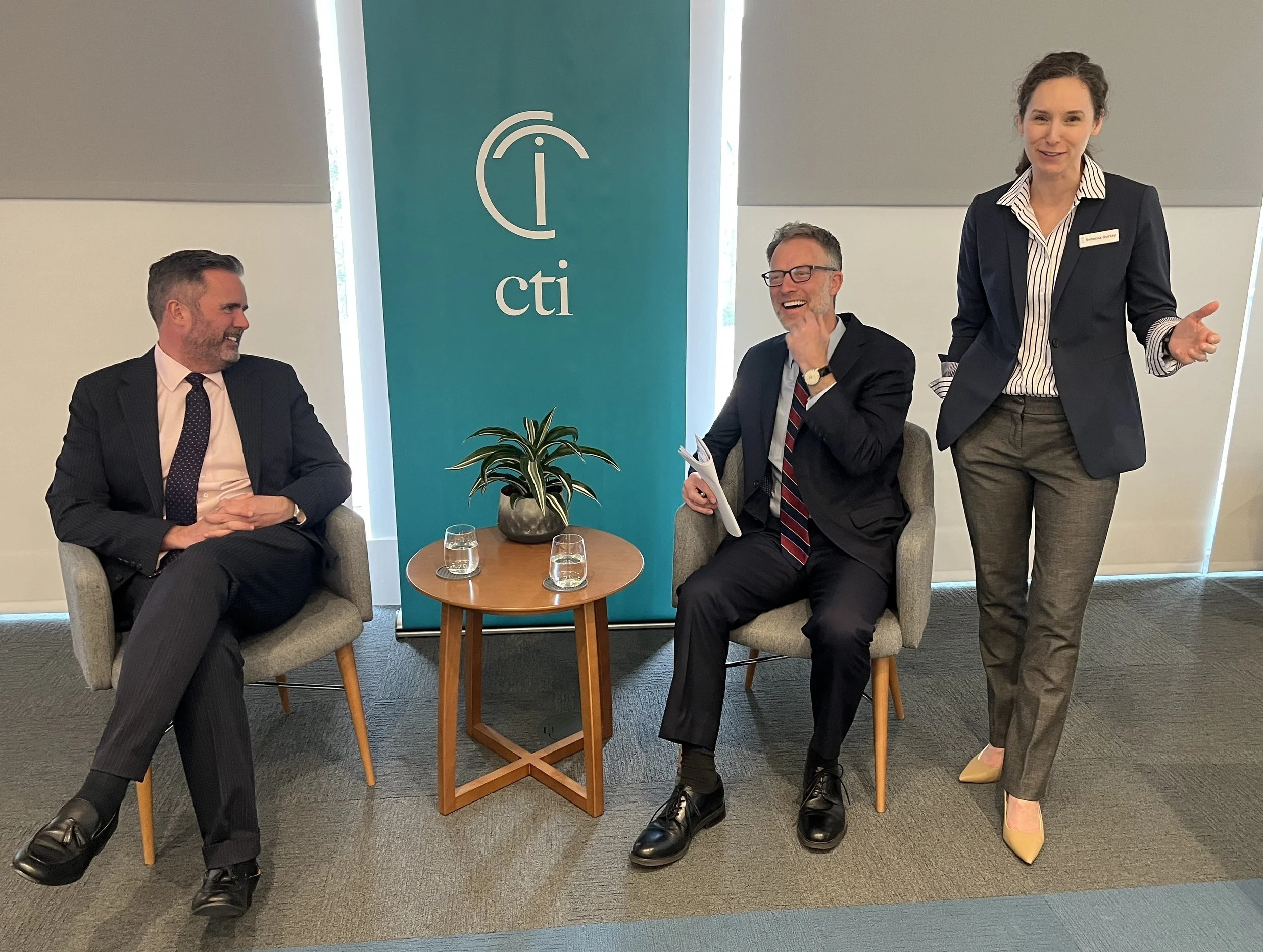
Tom Greggs, Joshua Mauldin, and Rebecca Dorsey open the Technology and AI Workshop
The workshop’s first day featured presentations from members of the AI residential cohort, each exploring AI from different disciplinary perspectives. Elise Edwards opened these presentations by offering a threefold framework for decision-making, distinguishing between machine learning, design thinking, and spiritual discernment. While AI excels at statistical pattern recognition and design thinking prioritizes human-centered problem solving, Edwards argued that spiritual discernment uniquely attends to questions of justice, personal formation, and the good—criteria that must ultimately govern whether and how AI is deployed.
Next, Laurie Zoloth placed current technological anxieties within a wider historical and philosophical setting and explained how the emergence of new forms of intelligence complicate traditional understandings of human being that prioritize rationality. Drawing on ancient and modern sources alike, Zoloth explored how longstanding definitions of human beings as “thinking things” must change given the advent of other thinking entities.
Thereafter, Henco van der Westhuizen drew on Charles Taylor, Hannah Arendt, and Jürgen Moltmann to reconsider the relationships between language, thought, and hope. He warned that contemporary AI systems, which treat language primarily as a computational tool, risk narrowing human self-understanding by reducing both thinking and hope to instrumental and predictive categories. In contrast, van der Westhuizen commended a richer, inherently relational anthropology and a robuster account of hope as openness to a future that exceeds calculation.
Other presentations addressed the ethical and theological implications of AI. Paula Sweeney examined how AI’s benefits and burdens are unevenly distributed, noting that while the technology significantly broadens access to elite services, it simultaneously threatens those who provide them. Drawing on Rawlsian and Scanlonian social justice frameworks, she intends to develop ethical criteria that furnish a principled distinction between instances in which resistance to AI is justified and instances in which its adoption is morally required.
In the final presentation of the day William Willimon emphasized that Christianity’s valorization of hope is unusual and that its commitment to hope as an eschatological reality inclines Christians to express their hope through poetic imagery rather than technical discourse. Greggs closed by suggesting that AI compels renewed reflection on the special characteristics of the human, and he pointed to love and the capacity to receive grace as two of them.
The workshop’s second day started with a synthesis of the previous day’s key claims and questions as distilled by CTI postdoctoral fellow Charles Guth. Guth identified the distinction (or lack thereof) between human and artificial intelligence, the nature and value of human personhood, and the conceptual complexity of hope itself. Subsequent panels brought external experts into focused conversation with the cohort. Clifford Anderson and Benjamin Glaser explored developments in digital and computational humanities, highlighting both the opportunities AI presents for theological inquiry and the challenges it poses to traditional forms of scholarly labor. Anderson noted that while AI is reshaping fields such as computer programming—transforming it from a craft into a form of oversight—it also raises fundamental questions that the humanities are uniquely equipped to address.
A second panel featuring Andrew Calis, Gretchen Huizinga, and Matthew Walther examined the ethical and practical dimensions of AI deployment. Huizinga, drawing on her experience in the technology sector, distinguished between “responsible” and “righteous” AI, arguing that the moral character of those who design and use these systems remains decisive. She also cautioned against the widespread technological pursuit of a frictionless “milieu of ease,” suggesting that such a world may ultimately undermine human flourishing.
In his closing reflections, Greggs returned to the workshop’s central concern with hope. While acknowledging that AI may offer forms of proximate or instrumental hope, he insisted that ultimate hope cannot be genuinely rooted in technology itself. Instead, Greggs maintained that theology has a crucial role to play in articulating a more enduring vision of hope capable of addressing the deeper sources of contemporary despair. In his judgment, the workshop underscored two enduring insights: that AI invites renewed inquiry into the nature of the human person, and that the fears it provokes echo longstanding cultural and theological narratives—from Prometheus to Frankenstein. Engaging these questions, he suggested, is precisely the task to which CTI’s From Despair to Hope project is dedicated. The gathering concluded with a final panel discussion and a closing dinner, marking not an endpoint but a continuation of the cohort’s shared work at the nexus of theology, technology, and hope.