
From April 13 to 15, the Center of Theological Inquiry (CTI) convened theologians, historians, and church leaders for a McDonald Agape Foundation Colloquium on Word and Sacrament Beyond Christendom. Building on the conversations and excitement of CTI’s Inauguration Weekend, the gathering extended and deepened CTI’s exploration of theology’s role in a rapidly shifting ecclesial and cultural landscape. Across a series of sophisticated presentations and wide-ranging discussions, participants examined how proclamation, sacrament, and ecclesial practice are being reconfigured in contexts where Christianity is no longer culturally central.
Prophetic Interruption and Transformed Presence
The colloquium opened with a presentation by Tom Greggs (CTI), who framed the proceedings with a synopsis of his pneumatological ecclesiology. Drawing on his ongoing Dogmatic Ecclesiology project, Greggs identified three “ontic experiences” of the Holy Spirit in the church—participation, encounter, and transformation—through which the body of Christ is constituted as a speaking and responsive community. Next, Greggs located the church’s identity within Christ’s threefold office of prophet, priest, and king. Noting that the prophetic dimension of ecclesial life is not an internal possession but an asymmetric interruption—a divine address that comes from without—Greggs argued that such interruption belies progressivist interpretations of history and tradition by attributing genuine transformation to divine initiative rather than immanent continuity. Greggs then explained that Christ’s ascension does not mark a diminishment but a pneumatological transformation of God’s presence that is no longer constrained by spatio-temporal limitations yet remains anchored in the concrete particularity of the Son’s incarnate life. Given such presence, Word and sacrament prove privileged sites where the risen Christ addresses and forms the church.
Inductive Theology, Contemporary Practice, and The Lord’s Supper
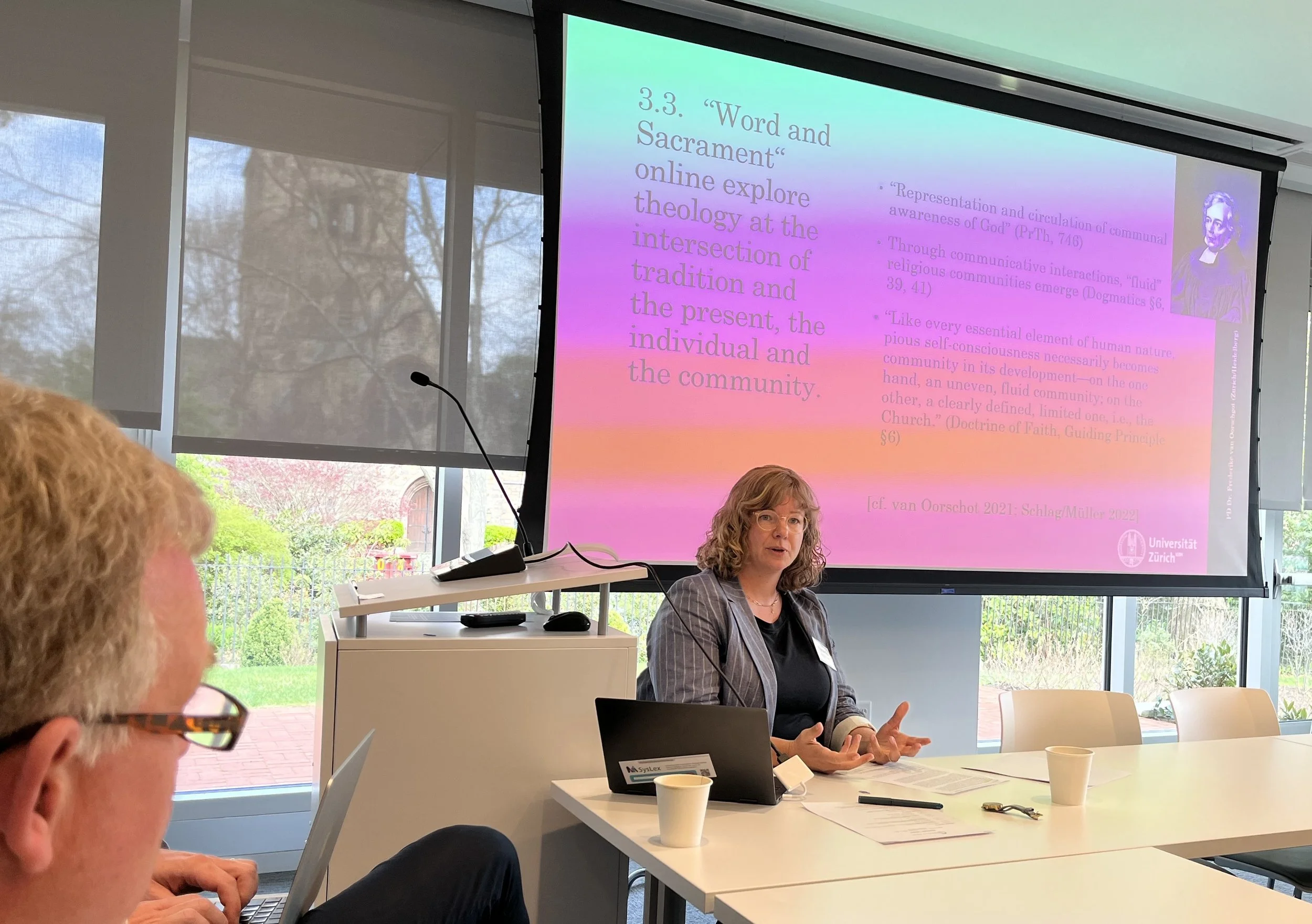
Frederike von Oorschot offers an inductive approach to word and sacrament in digital ecclesial life.
Frederike van Oorschot (Universities of Zurich and Heidelberg) broadened Greggs’ reflection by explicitly considering contemporary practices of faith, particularly in digital ecclesial contexts. Beginning with the classical Reformation claim that the church is marked by the preaching of the Word and the right administration of the sacraments, van Oorschot proposed an inductive approach to theology that starts from lived experience rather than abstract system. Utilizing categories of confession, community, and performance, she explored how online ecclesial practices may instantiate forms of Word and sacrament that challenge inherited assumptions about presence, mediation, and participation.
In the first day’s final session, Paul Nimmo (University of Aberdeen) focused van Oorschot’s discussion of sacramental theology by arguing that the Reformed tradition understands the Lord’s Supper as a human act of thanksgiving, renewal, and witness undertaken in response to divine grace. Affirming Karl Barth’s claim that thanksgiving is the basic posture of the covenant partner, Nimmo maintained that the Supper does not effect salvation but participates in its unfolding by bearing witness to a reconciliation with God that is both accomplished and awaited in Christ.
Proclamation, Witness, and Prayer
Philip Ziegler (University of Aberdeen) began the second day of the colloquium by appealing to the Barmen Declaration to contend that proclamation is central to Protestant ecclesiology. Interpreting proclamation as essentially a matter of witness, Ziegler used the concept capaciously to encompass not only preaching and public statements but also a form of life ordered toward the coming reign of Christ. Moreover, because proclamation as witness is irreducibly Christological and eschatological, Ziegler contended that it properly culminates in prayer, namely the petition that the God proclaimed would be present and active.
William Willimon (Duke University) elaborated on the eschatological orientation of proclamation that Ziegler identified by reflecting on the homiletical significance of surprise. In a cultural context that increasingly values usefulness over truth, Willimon insisted that Christian proclamation must resist reduction to pragmatic utility by resolutely bearing witness to the unexpected, disruptive reality of God’s action in Christ.
Ignatian Formation, Racial Reconciliation, and Reimagining the Big Tent
After lunch at Princeton Theological Seminary, Gemma Simmonds (Margaret Beaufort Institute) introduced an overtly spiritual perspective to the colloquium by delineating the dynamics of Ignatius’ Spiritual Exercises. Describing a process of formation that prioritizes prayer, discernment, and transformative encounter with divine grace, Simmonds explained how the Exercises’ cultivation of receptivity to God enables a movement from self-knowledge to participation in the life of Christ.
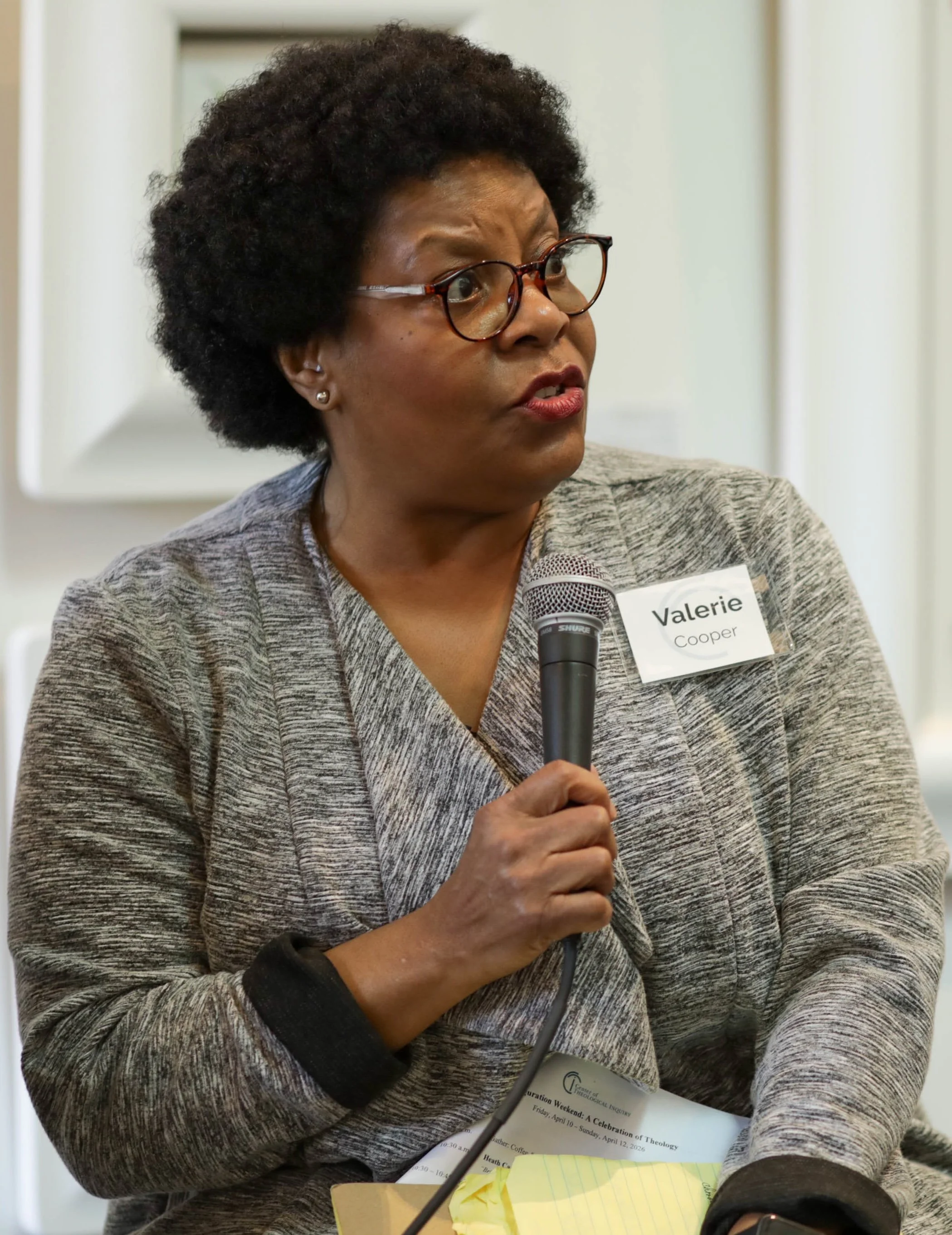
Valerie Cooper delivers a presentation entitled “Black Deaths Matter, Too: Racial Reconciliation after the Massacre at Mother Emmanuel AME Church in Charleston, SC.”
Valerie Cooper (Duke University) developed the ethical implications of such spiritual formation by blending sociological analysis and theological critique to explore race relations in the wake of the June 17, 2015 massacre at Mother Emanuel AME Church in Charleston, South Carolina. Contextualizing contemporary American racial divisions within a history of ecclesial complicity and continuing congregational segregation, Cooper argued that the religious revivals and awakenings that might otherwise overcome these longstanding divides through their transcendence of entrenched identities have been dissipated by Christian disunity. Yet just as church factiousness manifests and exacerbates racial discord, Cooper urged that genuine church communion can catalyze and realize racial reconciliation.
In the day’s final presentation, Heath Carter (Princeton Theological Seminary) extended Cooper’s historical analysis by contesting the received “great divorce” account of twentieth-century American Protestantism with an alternative genealogy in which earlier forms of evangelicalism were marked by deliberate commitment to cooperative social engagement. Tracing the rise and eventual fragmentation of this “big-tent” Protestantism, Carter highlighted the tensions inherent to attempts to sustain unity across doctrinal and political differences. His analysis underscored the colloquium’s repeated recognition that the church’s identity is continually negotiated amid Christianity’s calls to holiness and mission.
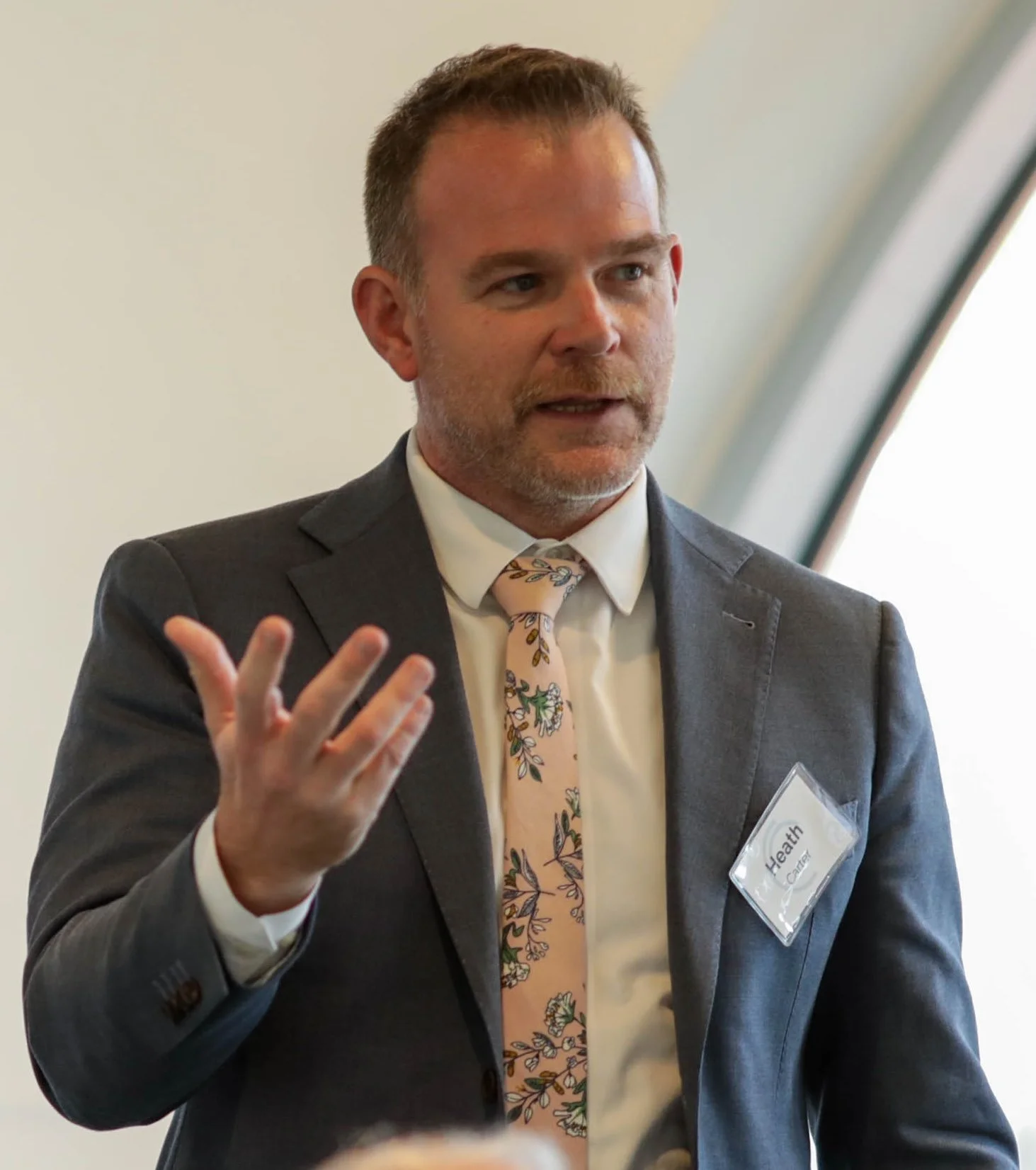
Heath Carter explores the history and possibility of a “bigger-tent” church.
Ordination, Embodiment, and Apologetics
Reconsidering the pastoral role amidst institutional contraction, Edwin Chr. Van Driel (Pittsburgh Theological Seminary) opened the last day of the colloquium by commending John Calvin’s contention that ordained ministers function as ambassadors of Christ and so are authorized to speak and act in God’s name through the proclamation of the Word and administration of the sacraments. Noting that ordination so conceived proves more a matter of discerned vocation and ecclesial recognition than credentialing or professional training, Van Driel suggested that such a reconceptualization may allow the church to sustain its witness as denominational structures become increasingly unstable.
Luke Powery (Duke University) subsequently explored the embodied character of proclamation by emphasizing that preaching is incarnational as well as interpretive, and hence a matter of deed along with word, flesh along with sound. Through virtuoso vocal performance and theological reflection, Powery foregrounded the ways that proclamation participates in the embodied reality of Christ’s life, death, and resurrection.
Thereafter, John Swinton (University of Aberdeen) deepened Powery’s emphasis on embodied proclamation by examining what it means to communicate the Word to those for whom verbal language is inaccessible or insufficient. Harnessing scripture and doctrine, Swinton presented a multivocal understanding of proclamation wherein the church’s community life becomes a primary medium of the gospel’s intelligibility, particularly in post-Christendom contexts.
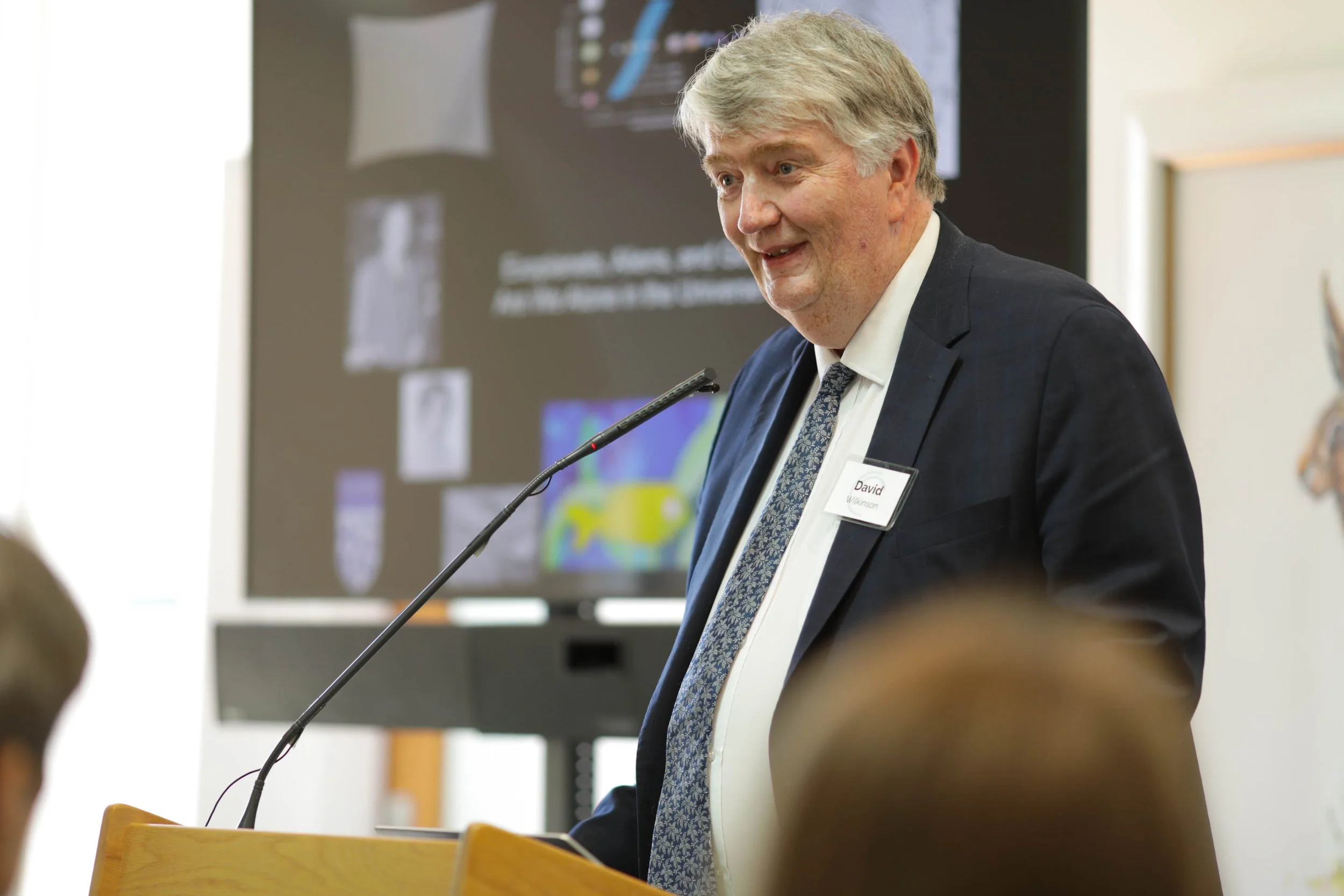
David Wilkinson proposes a new form of Christian apologetics.
David Wilkinson (Durham University) concluded the colloquium by proposing that with the passing of Christendom, Christian apologists should cultivate an intellectual and imaginative environment hospitable to faith rather than recur to prior generations’ defensive and adversarial modalities. Appreciatively engaging with the work of Alister McGrath and the witness of John Polkinghorne, Wilkinson accentuated the importance of affirming the goodness of creation while also upholding the gospel’s confrontation and transformation of deleterious cultural assumptions and arrangements.
Word and Sacrament after Christendom
For all their disciplinary, doctrinal, and denominational diversity, the colloquium’s various presentations were united by a common commitment to exploring how Word and sacrament should be understood and enacted in settings where the church has been culturally marginalized. Among an array of answers, several common themes emerged. First, the church is fundamentally responsive, constituted by divine address and action rather than human initiative. Second, since proclamation and sacrament are irreducibly embodied and communal, they require concrete expression and shared forms of life. Third, ecclesial practices must be reimagined without being relinquished as the church adapts to a post-Christian milieu.
If the Inauguration Weekend articulated a renewed vision for theology at CTI, the McDonald Agape Foundation Colloquium demonstrated how that vision might be practically pursued. By combining doctrinal analysis, historical assessment, and reflection on contemporary experience, the gathering exemplified CTI’s commitment to rigorous, interdisciplinary inquiry in the service of church and world.