
Mark Noll Explores Princeton’s Tradition of Learning and Faith in CTI Lecture
Renowned American historian Mark Noll visited the Center of Theological Inquiry (CTI) on May 18 to deliver a lecture entitled “Sustaining an Intellectual Vision: Education and Piety at Princeton, 1768–1932.” The event was moderated by Heath Carter, Associate Professor of American Christianity at Princeton Theological Seminary, and attracted faculty and students from the Seminary and Princeton University in addition to CTI scholars and staff.
Synthesizing decades of scholarship in American religious history, Noll documented the development of a distinctive Princeton tradition that sought to unite Christian devotion with intellectual excellence. Noll identified John Witherspoon—the Scottish Presbyterian minister who arrived in Princeton in 1768 to become president of what was then the College of New Jersey—as this tradition’s principal progenitor. Although the College was only twenty-four years old and had already churned through five presidents, including Aaron Burr Sr. and Jonathan Edwards, Witherspoon's inaugural commencement address, “The Connection and Mutual Influence of Learning and Piety,” articulated a vision that would shape Princeton for generations.
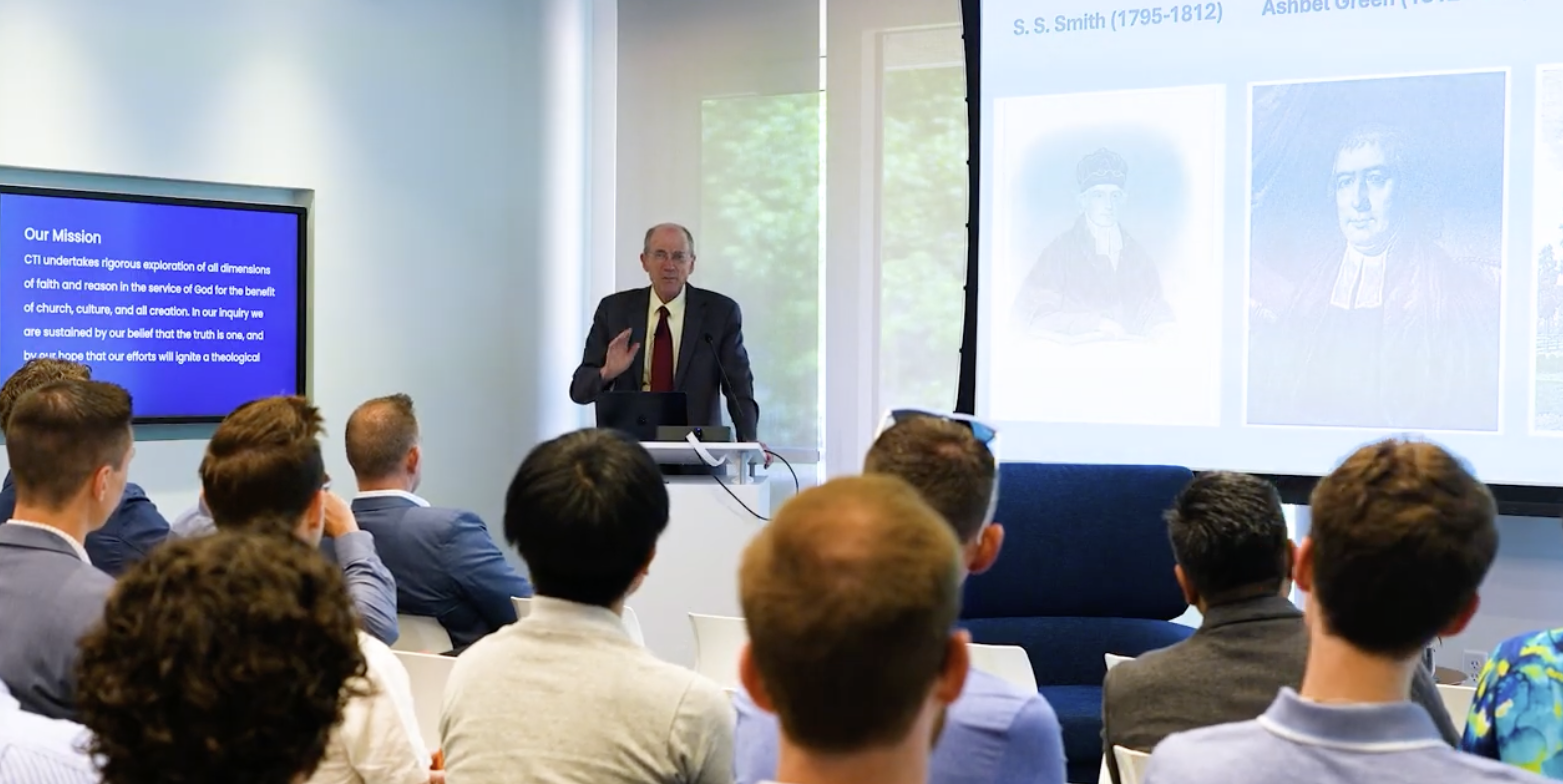
Mark Noll lecturing in the CTI Garden Room.
An evangelical Calvinist, Scottish Common Sense philosopher, republican statesman, and influential churchman, Witherspoon believed faith and learning were complementary and synergistic rather than unrelated or antagonistic. Admittedly, under Witherspoon's leadership, the proportion of College of New Jersey graduates entering ordained ministry declined from roughly a half to a fifth. Nevertheless, Noll contended that this development did not represent a diminution of Christian commitment but its expansion into civic leadership. Indeed, Witherspoon himself was not only a Presbyterian clergyman but also a college president and signatory of the Declaration of Independence.
Noll traced this distinctive Princeton tradition through the administration of several College of New Jersey presidents. He also noted that as the College became increasingly devoted to educating its students for various forms of civic leadership, the Presbyterian church that had founded and continued to sponsor the College grew commensurately concerned about the decreasing number of clergy the College was producing. This concern catalyzed the creation of Princeton Theological Seminary in 1812 and prompted Noll to discuss Charles Hodge’s role in developing and disseminating Witherspoon’s intellectual vision.
Hodge was the Seminary’s principal nineteenth century intellectual figure, serving on its faculty for more than fifty years and establishing the Princeton Review as one of the nation’s leading scholarly journals. According to Noll, Hodge trained more graduate students than anyone else in America over this period, thereby extending Witherspoon’s intellectual vision far beyond Princeton. Meanwhile, within Princeton, Noll highlighted the close relationship between Hodge and Joseph Henry, the eminent scientist who taught at the College of New Jersey before becoming the first Secretary of the Smithsonian Institution. Though the two men disagreed sharply over Charles Darwin’s theory of evolution by natural selection—with Henry accepting it and Hodge notoriously denouncing it as atheistic—their friendship endured. Indeed, Hodge delivered Henry’s funeral eulogy in what became his final public appearance, an episode Noll presented as exemplifying the intellectual seriousness and mutual respect that characterized the Princeton tradition at its best.
Throughout the lecture, Noll emphasized the longstanding cooperation between what would become Princeton University and Princeton Theological Seminary. Far from existing as isolated institutions, the two frequently strengthened one another, sharing intellectual resources and sustaining a common commitment to Christian learning. For example, Henry was a trustee of the Seminary while Hodge was a graduate and trustee of the College. This partnership—personal, institutional, and ecclesial—helped cultivate what Noll described as the conviction that “Presbyterian learning is not an oxymoron,” a confidence that shaped Princeton well into the early twentieth century, when it was dissipated by the University’s disinterest in sustaining a Presbyterian ethos and the Seminary’s retreat from appreciative engagement with scholarly advance.
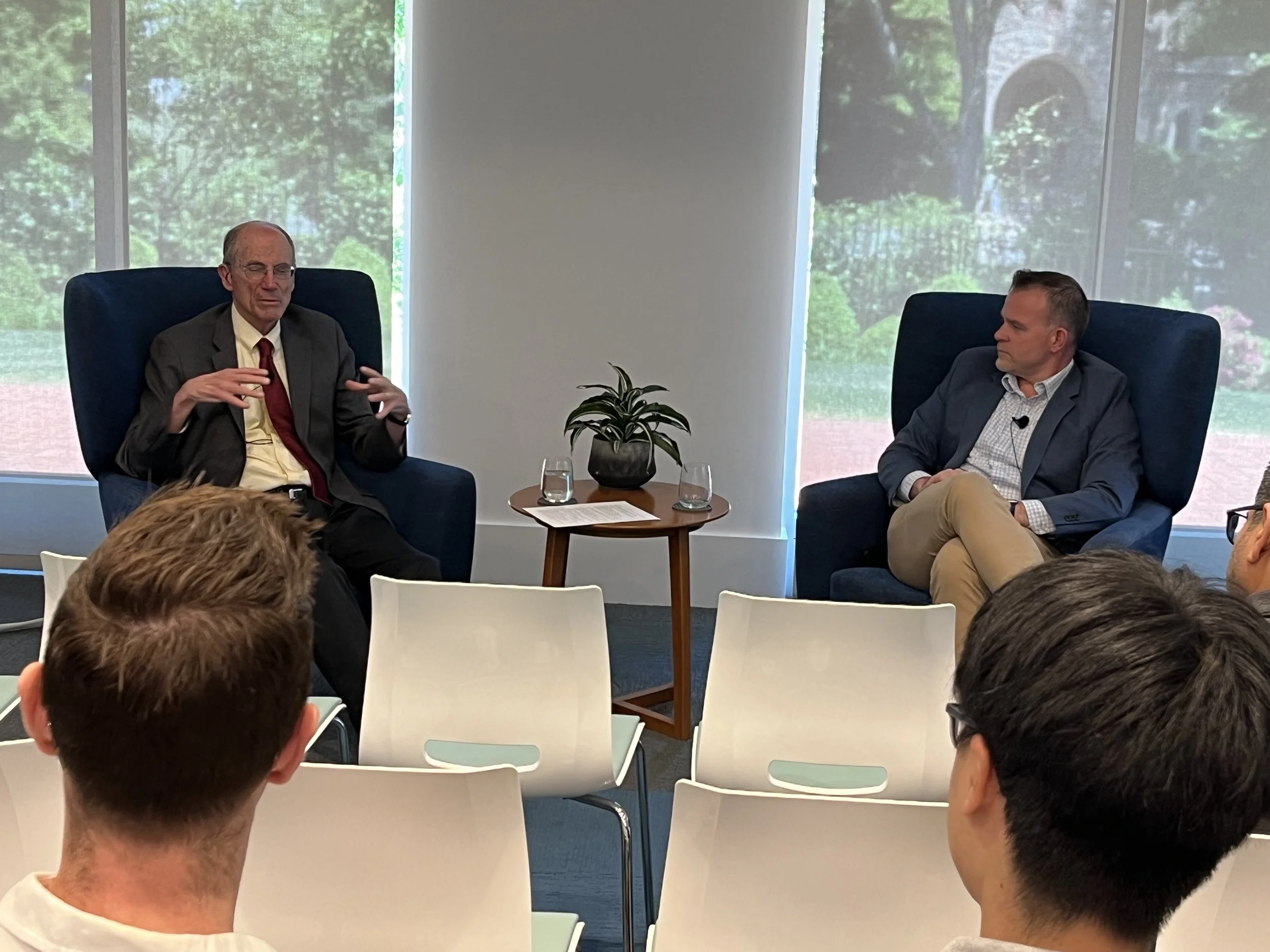
Mark Noll fields audience questions as Heath Carter moderates.
During an extensive question-and-answer session, participants explored the implications of this history for contemporary theological teaching and research. Responding to a question from Carter about whether the separation of the College and Seminary compromised Christian liberal arts education, Noll countered that the robust faculty exchange in the Princeton Review and broader intellectual collaboration between the institutions throughout the nineteenth century arguably allowed theology to exert greater influence on Princeton’s overall academic culture than proved possible at Harvard and Yale, where theology became sequestered within these universities’ Divinity Schools.
Other questions probed the relationships between natural scientific methodology and Calvinistic moral theology, compared Witherspoon’s efforts to overcome the schism between Old and New Light Presbyterians with Hodge’s attempts to reconcile the Old and New School Presbyterians, and addressed the eventual divergence of the University and Seminary. Noll maintained that although the historical circumstances of Witherspoon’s era differ dramatically from those that are regnant now, the aspirations that animated his intellectual vision remain relevant and laudable.
Asked what Witherspoon’s legacy might mean today, Noll offered a succinct answer: theological scholarship and teaching should embrace the wider world of learning without becoming captive to it. Given the rich consonance between this account of Witherspoon’s intellectual vision and CTI’s mission, Noll’s lecture afforded a concise overview of the roles that education and piety have played in Princeton and an inspiring recognition of the ways in which CTI continues to demonstrate and amplify the fecundity and significance of this tradition—in Princeton and beyond.